

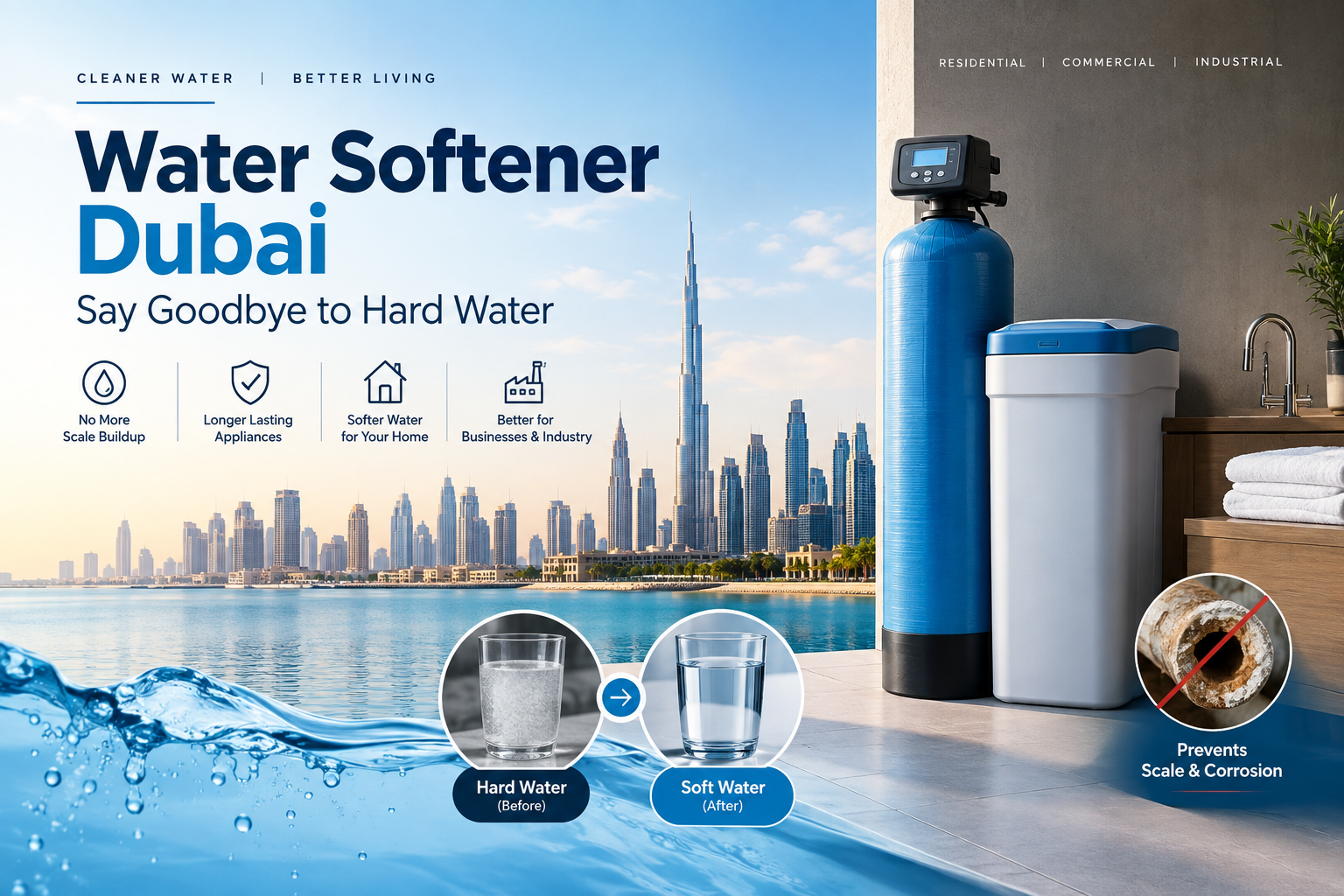
Water Softener Dubai: Say Goodbye to Hard Water
Hard water can quietly create problems long before you notice serious damage. A white film around taps, scale inside water heaters, reduced soap performance, rough-feeling laundry and deposits inside plumbing can all point toward elevated water hardness. A water softener in Dubai is designed specifically to address hardness caused mainly by dissolved calcium and magnesium, making it an important part of many residential, commercial and industrial water-treatment strategies. The World Health Organization explains that hardness is primarily associated with calcium and magnesium and can affect water acceptability as well as operational considerations.
For Dubai property owners and businesses, the right treatment approach should begin with understanding the actual water entering the building rather than simply buying the largest available unit. Dubai's potable water is treated and monitored, and DEWA's 2025 sustainability reporting states that its potable water production, transmission and distribution comply with the latest WHO drinking-water guidelines. DEWA's reported typical total-hardness figure for its Jebel Ali Power and Desalination Complex water in 2024 was 61.3 mg/L as CaCO₃, within its stated specification range. At the same time, individual properties, storage tanks, internal plumbing, alternative sources and specific industrial processes can create different treatment requirements. That is why a professional assessment is more useful than assuming every building needs exactly the same solution.
Why Hard Water Matters in Dubai
Hard water is not simply a matter of whether water tastes good or bad. From an engineering perspective, hardness can influence how water behaves with soap, heating equipment, pipes, fittings and process systems. Calcium and magnesium ions are the primary contributors to hardness, and when conditions are suitable, dissolved minerals can contribute to scale formation on surfaces and inside equipment. The WHO notes that hardness is generally not considered a health concern at levels found in drinking water, but it can affect acceptability and has important operational implications.

That distinction matters when choosing a water softener Dubai solution. A softener is not automatically a replacement for every other water-treatment technology, and it should not be marketed as if it removes every contaminant from water. Its core job is hardness reduction. Depending on the source water and application, a complete treatment train may also require sediment filtration, activated carbon, reverse osmosis, UV, disinfection, antiscalant dosing or other technologies. UltraTec's UAE portfolio includes water softeners alongside RO systems, filters, deionization and other water-treatment technologies, allowing treatment to be designed around the actual application instead of forcing every water problem into one system.
What Is Water Hardness?
Water hardness is primarily associated with dissolved calcium and magnesium. The concentration is commonly expressed as milligrams per litre of calcium carbonate equivalent, or mg/L as CaCO₃. WHO reference material commonly categorizes water below 60 mg/L as soft, 61–120 mg/L as moderately hard, 121–180 mg/L as hard and above 180 mg/L as very hard, although classification systems can differ between organizations and applications.
Why does this matter in practical terms? Think about a kettle that slowly develops a chalky layer inside it. The water may still look completely normal when poured into the kettle, but repeated heating can encourage mineral deposits to accumulate. Similar processes can occur in hot-water systems, boilers, pipes, shower fittings and other equipment. Hardness also reduces soap's ability to lather efficiently, which can make cleaning and washing feel less effective.
A proper water analysis can identify the hardness level and help determine whether softening is necessary. For commercial and industrial projects, the assessment should go beyond hardness alone and consider flow rate, peak demand, water temperature, source-water chemistry, required treated-water quality, operating hours and downstream equipment. That information allows an engineer to select a system that is appropriately sized rather than unnecessarily oversized or too small for the application.
Is Hard Water Unsafe?
Hard water should not automatically be described as unsafe drinking water. WHO's current hardness information explains that hardness at levels normally found in drinking water is not considered a health concern and that no specific health-based guideline value has been established for hardness. The issue is more closely related to acceptability, mineral composition and operational effects such as scaling.
This is an important distinction for homeowners and businesses searching for a water softener in Dubai. The purpose of softening is generally not to turn unsafe water into safe drinking water. Instead, it is used to reduce hardness and its associated effects. If the concern is bacteria, dissolved salts, heavy metals, unpleasant taste, high TDS or other contaminants, a different treatment technology may be required. For example, reverse osmosis is designed for a different treatment objective from a conventional ion-exchange softener.
The best approach is therefore to test first and treat according to the results. For potable water, DEWA reports that Dubai's supplied potable water complies with the latest WHO drinking-water guidelines. For private tanks, industrial water, groundwater or process water, however, the appropriate treatment strategy should be determined from the actual water analysis and intended use.
Why Install a Water Softener in Dubai?
A properly designed softening system can provide practical benefits throughout a property. The biggest advantage is usually better control of mineral scaling, particularly where heated water is involved. Reducing hardness can help protect equipment and improve the performance of soaps and cleaning products, while potentially reducing the frequency of scale-related maintenance. WHO and other technical drinking-water references recognize these operational considerations as an important reason why hard water may be softened.
The value becomes even clearer when a building contains several water-consuming systems. A residential villa might have multiple bathrooms, water heaters, washing machines and kitchen appliances. A hotel can have hundreds of bathrooms and a substantial hot-water system. A factory may operate boilers, cooling systems, process equipment or production lines where hardness control is part of a broader water-treatment strategy. In each situation, the cost of untreated scaling can extend beyond visible deposits, which is why softening is often considered as part of preventive maintenance.
Benefits for Homes
For homes and villas, a whole-house water softener Dubai system can be designed to treat water entering selected parts or the entire property. Softer water generally works more effectively with soap, can reduce mineral deposits around fixtures and may help control scale in water heaters and household plumbing. UltraTec specifically describes its softening systems as removing calcium and magnesium and notes their compatibility with soap and their role in extending the service life of household equipment such as water heaters.

The everyday difference can be surprisingly noticeable. Imagine cleaning a shower screen every few days because a cloudy mineral film keeps returning. Or imagine replacing a heating element earlier than expected because scale has accumulated around it. These are the types of maintenance frustrations that can make hardness control worthwhile. A correctly sized system can make water management easier while supporting the longer-term performance of equipment.
Soft water can also improve the feel of washing and reduce the amount of visible mineral residue on taps, shower fittings and glass. However, it is important not to confuse a softener with a complete drinking-water purifier. If the objective is to improve drinking-water quality, taste or dissolved-solids levels, the softener may need to work alongside another treatment stage such as RO or carbon filtration.
Benefits for Commercial and Industrial Facilities
Commercial and industrial facilities often have much more to gain from properly engineered hardness control because water is connected directly to operating costs. Hotels, restaurants, laundries, hospitals, residential towers, manufacturing plants and other facilities may operate equipment that is sensitive to mineral scaling. When scale accumulates inside heat-transfer surfaces, boilers or other components, heat-transfer efficiency and maintenance requirements can be affected.
UltraTec provides industrial water-softening systems designed around industrial applications, using resin-based softening to reduce hardness and offering customizable softening programs and maintenance support. Industrial treatment should always be designed according to the actual process because flow rates and water-quality requirements can vary significantly from one facility to another.
For a factory, the right question is therefore not simply, “What is the cheapest industrial water softener?” A better question is, “What treatment capacity and configuration will reliably meet the process requirement at an acceptable lifecycle cost?” That shift from purchase price to lifecycle performance can make a substantial difference in commercial water-treatment decisions.
How Does a Water Softener Work?
A conventional water softener typically uses ion exchange to reduce hardness. Water passes through a vessel containing specially selected resin beads. Calcium and magnesium ions responsible for hardness are exchanged with ions held by the resin, traditionally sodium in many softening systems. Once the resin's exchange capacity is substantially consumed, the system needs regeneration so it can continue operating.
UltraTec describes its industrial systems as using resin to remove hardness, with the resin regenerated periodically using a salt/brine process. The exact design can vary according to capacity, application, control valve, water chemistry, flow requirements and desired treated-water characteristics. This is why professional sizing matters.
The Role of Ion Exchange Resin
The resin is essentially the working medium that performs the hardness exchange. During normal operation, untreated water passes through the resin bed, where calcium and magnesium are captured by the resin. The treated water then continues toward the building's plumbing or process equipment.
Over time, the resin becomes increasingly loaded with hardness ions. If regeneration did not occur, the softener would eventually lose its ability to provide the required treated-water quality. Resin selection and operating conditions therefore have a direct relationship with system performance.
For commercial applications, engineers also need to consider pressure drop, service flow, regeneration frequency, water temperature, salt consumption and the characteristics of the incoming water. A system that works well in a small villa cannot simply be scaled up by installing a larger tank without considering the hydraulic and operational requirements.
Regeneration and Salt Management
Regeneration restores the resin's exchange capacity. In a conventional salt-regenerated softener, a brine solution is passed through the resin during the regeneration cycle. The concentrated salt solution helps displace accumulated hardness ions from the resin, allowing the resin to return to a condition suitable for another service cycle.
Modern systems can be configured with automatic control valves and programmed regeneration cycles, helping reduce the need for constant manual intervention. However, salt and water consumption remain important considerations. The most efficient system is not necessarily the one with the largest resin volume; it is the one that matches the property's actual demand and water chemistry.
For this reason, installation should be followed by routine monitoring. Salt levels, regeneration settings, leakage, valve operation, resin condition and incoming water quality should all be considered during maintenance. Proper service can help maintain consistent performance and prevent small issues from becoming expensive equipment problems.
Water Softener vs RO System
A water softener and a reverse osmosis system perform different jobs, so comparing them as direct substitutes can lead to the wrong purchasing decision. A softener is primarily designed to reduce hardness, particularly calcium and magnesium ions. RO uses a semipermeable membrane and pressure to reduce a broad range of dissolved substances, making it suitable for applications where lower TDS or more extensive dissolved-contaminant reduction is required.
UltraTec supplies both softening systems and RO technologies in the UAE, reflecting the fact that water treatment often requires different technologies for different objectives. For example, a villa may use a softener for general household water while using a separate RO unit for drinking water. An industrial facility may use softening as pretreatment before RO, depending on the feed-water chemistry and system design.
| Feature | Water Softener | Reverse Osmosis |
|---|---|---|
| Primary purpose | Reduce hardness | Reduce dissolved salts and many contaminants |
| Main technology | Ion exchange | Membrane separation |
| Calcium & magnesium | Specifically targets hardness ions | Can significantly reduce them |
| TDS reduction | Not the primary purpose | Major treatment objective |
| Scale control | Strong application | Often used with pretreatment for membrane protection |
| Typical use | Whole-house, commercial, industrial | Drinking water, process water, desalination |
| Salt/brine | Common in conventional systems | Not used for membrane separation itself |
| Best selection method | Based on hardness and flow | Based on TDS, feed chemistry, recovery and required quality |
When Should You Choose a Water Softener?
Choose a softener when hardness is the primary problem you are trying to control. Typical signs include recurring scale around fixtures, deposits inside hot-water equipment, poor soap performance and process requirements that call for reduced hardness. The system should be sized using measured hardness and expected water consumption rather than simply selecting a product based on tank size.
Choose RO when the requirement involves broader dissolved-solids reduction or production of highly treated water. In many commercial and industrial installations, the two technologies can work together rather than compete with each other. Softening can be part of pretreatment, while RO handles a different water-quality objective.
The right combination depends on the feed water. DEWA's reported 2024 data, for example, showed typical potable-water TDS of 216 mg/L and total hardness of 61.3 mg/L as CaCO₃ for the cited Jebel Ali Power and Desalination Complex water data, while groundwater used for emergency purposes had an average TDS above 1,000 mg/L. Those figures illustrate why water source and application matter when specifying treatment equipment.
How to Choose the Right Water Softener
Choosing the right water softener Dubai system is less about finding a product with the biggest tank and more about matching the treatment equipment to actual demand. A professional specification normally considers incoming hardness, daily water consumption, peak flow, number of users, application, water temperature and downstream equipment.
For industrial facilities, additional factors may include continuous operation, process requirements, regeneration windows, redundancy, automation, available installation space and the consequences of treated-water failure. A system for a small office should not be engineered in the same way as a hotel, hospital or manufacturing plant.
Sizing Your Softener Correctly
Correct sizing is one of the most important parts of softener selection. If the unit is undersized, it may exhaust its exchange capacity too quickly and regenerate more frequently than practical. If it is significantly oversized, the initial investment and operating requirements may be unnecessarily high.
A professional assessment should calculate the approximate hardness load based on water consumption and hardness concentration. Peak flow is also important because a system must provide adequate flow without creating unacceptable pressure loss.
For example, a villa with intermittent household demand has very different requirements from a hotel with continuous showers, laundry and hot-water usage. Likewise, an industrial process may require a constant treated-water supply, making duplex or duty/standby configurations more appropriate than a single basic vessel.
Maintenance and Operating Requirements
A water softener is not a “fit and forget” appliance. It needs appropriate maintenance to maintain performance over time. Conventional systems require monitoring of salt supply, regeneration cycles, control valves, resin condition and the quality of water entering and leaving the system.
The frequency of maintenance depends on usage and system design. Commercial and industrial users should establish a planned maintenance schedule rather than waiting until scale appears. Periodic water testing can also help verify that the system is achieving its intended performance.
UltraTec states that its services include installation and maintenance of water-treatment systems and provides customized industrial softening programs. This service approach is particularly valuable for businesses where treatment equipment is part of daily operations rather than simply a household convenience.
Water Softener Applications Across the UAE
The need for hardness management can appear across many different UAE environments. In residential villas and apartments, the focus is commonly on plumbing, bathrooms, water heaters, appliances and everyday cleaning. Hotels and hospitality properties have a much larger water footprint, meaning scale control can become part of equipment-maintenance planning.
Commercial buildings can also benefit when water is used extensively in HVAC-related systems, kitchens, washrooms or other services. Industrial facilities have even more specialized requirements, with water quality potentially affecting production, boilers, cooling systems, cleaning processes and other operations.
UltraTec operates from Dubai and provides water-treatment solutions for domestic, commercial and industrial applications. Its website identifies services and products including water softeners, RO plants, filtration systems and other treatment technologies, while its industrial softener offering specifically covers Dubai and the UAE.
For projects in Dubai, Abu Dhabi and Sharjah, the treatment strategy should be adapted to the source water and application rather than copied from another building. UAE conditions also make reliability, maintenance access and equipment durability important considerations. A professional water-treatment company can assess the system requirement, recommend the appropriate treatment train and support installation and maintenance.
Why Choose UltraTec Water Treatment LLC?
UltraTec Water Treatment LLC has operated in the water-treatment sector since 1999 and provides domestic, commercial and industrial water-treatment solutions in the UAE. Its published company profile states that the business has expanded its water-treatment work across multiple countries and lists ISO 9001 certification and Water Quality Association membership among its credentials.
For customers specifically looking for a water softener Dubai supplier, the company offers both general water-softening solutions and industrial systems. Its industrial softener page describes resin-based hardness reduction and customizable programs, while the company's broader portfolio includes RO plants, filtration, deionization, UV-related technologies, water-treatment components and maintenance services.
Explore UltraTec's industrial water softener solutions
For businesses, the advantage of working with a company offering multiple treatment technologies is that the recommended solution does not have to stop at softening. If testing shows that the application also requires filtration, RO, deionization or another process, the treatment system can be considered as a complete water-treatment train.
Learn more about UltraTec's water-treatment capabilities
UltraTec lists its Dubai warehouse/showroom near Arabian Adventures in Dubai Investment Park 2, along with UAE contact numbers and email addresses. For a new installation or replacement project, customers can request an assessment based on their water source, hardness, flow requirements and intended application.
Water Softener Cost in Dubai: What Affects Pricing?
There is no responsible single price for every water softener in Dubai because the required system can range from a domestic unit to a large automated industrial installation. Pricing depends on capacity, resin volume, control valve, vessel configuration, regeneration method, water quality, flow requirement, installation complexity and maintenance requirements.

A small residential system may be designed around household consumption, while an industrial system could require multiple vessels, automated controls, larger brine tanks and duty/standby configurations. Additional pretreatment may also be required if the incoming water contains sediment, iron, turbidity or other issues that could interfere with the softening process.
When comparing quotations, it is therefore better to compare the complete solution rather than the equipment price alone. Ask what capacity is included, what hardness level the system is designed for, how regeneration is controlled, what consumables are required, whether installation is included and what after-sales support is available.
A low-cost unit that is poorly sized can become expensive through excessive regeneration, premature maintenance or inadequate treatment. Conversely, an oversized system can tie up capital unnecessarily. The best-value solution is normally the one that provides the required treated-water quality with sensible operating and maintenance costs over its expected service life.
Conclusion
A water softener Dubai system can be a practical solution when calcium and magnesium hardness is creating scale, cleaning difficulties or equipment-maintenance concerns. Hardness itself is not automatically a sign that water is unsafe; WHO considers hardness primarily an acceptability and operational parameter rather than a health-based contaminant at normal drinking-water concentrations.
For Dubai properties, the right solution should begin with the actual water quality and intended application. A domestic villa may need a whole-house softener, while a hotel, commercial building or industrial facility may require a larger automated system or a combination of softening, filtration and RO technologies.
UltraTec Water Treatment LLC provides water-softening, filtration, RO and broader water-treatment solutions in Dubai and across the UAE. If you are dealing with recurring scale, equipment problems or a commercial process that requires hardness control, a professional assessment can help determine the right system before you invest.
Need a water softener for your home, commercial property or industrial facility in Dubai? Contact UltraTec Water Treatment LLC for a solution designed around your water quality, capacity and application.
Frequently Asked Questions
1. What does a water softener do?
A water softener primarily reduces calcium and magnesium ions responsible for water hardness. Conventional systems commonly use ion-exchange resin and regeneration to maintain treatment capacity.
2. Is a water softener the same as an RO system?
No. A softener primarily targets hardness, while reverse osmosis uses a membrane to reduce dissolved salts and a broader range of dissolved substances. Depending on the application, both technologies may be used together.
3. Do I need a water softener in Dubai if my water comes from DEWA?
Not every property automatically needs one. DEWA reports that its potable water complies with WHO drinking-water guidelines, and its published water-quality data show total hardness within its stated specification. Whether softening is useful depends on the property's plumbing, storage, equipment and specific water-treatment requirements.
4. How often does a water softener need regeneration?
Regeneration frequency depends on water hardness, water consumption, resin capacity and system programming. Proper sizing and configuration are important because an undersized system may regenerate more frequently than necessary.
5. Can UltraTec supply industrial water softeners in Dubai?
Yes. UltraTec publishes dedicated industrial water-softener solutions for Dubai and the UAE, including resin-based systems and customizable softening programs.