

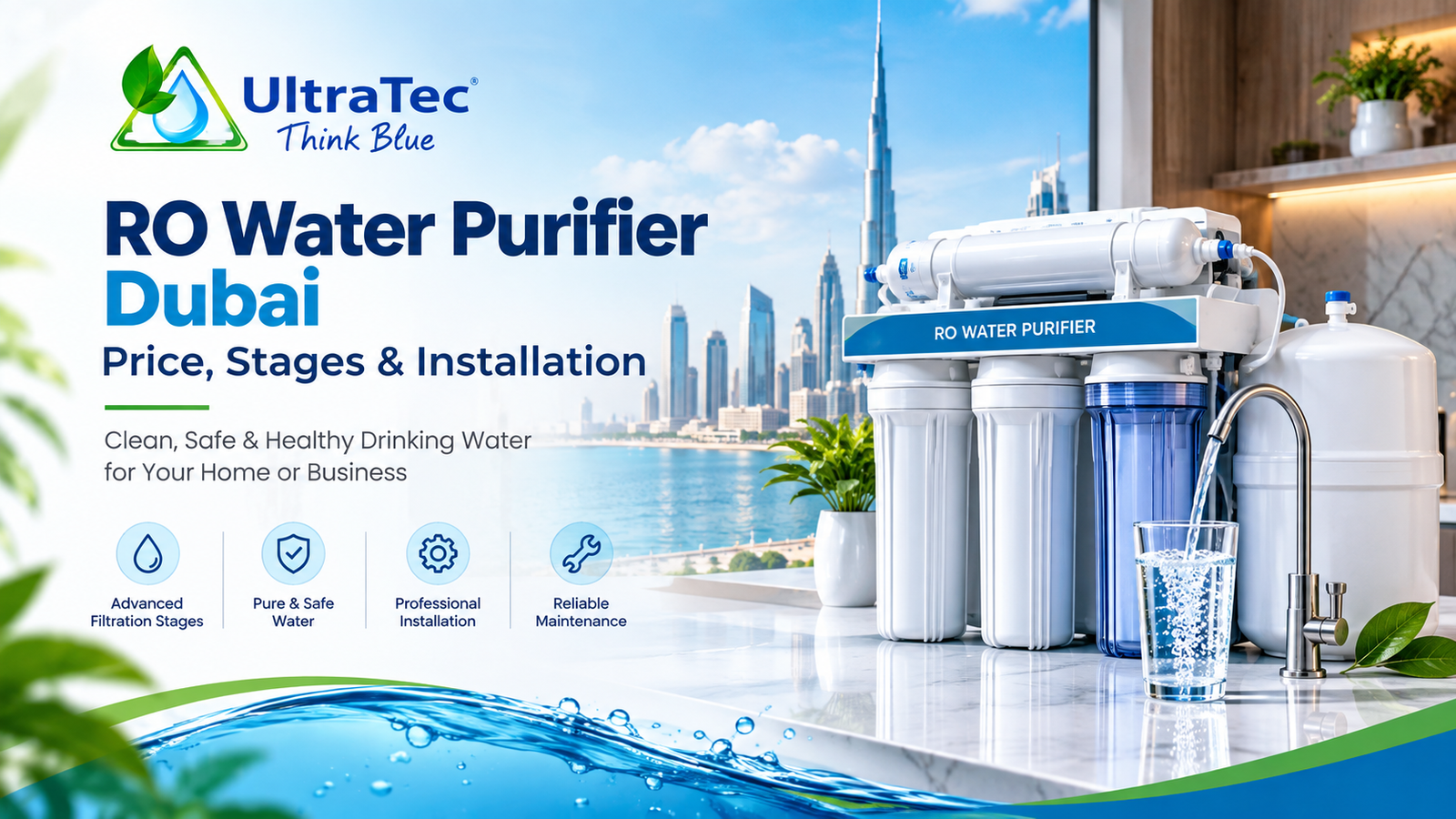
Which RO Water Purifier Do You Need?
If you need an RO water purifier in Dubai, the right system depends on your incoming water quality, required daily capacity, available installation space and the purpose of the treated water. A small domestic RO system can be suitable for drinking and cooking, while restaurants, offices, hotels, schools and industrial facilities may require a higher-capacity commercial RO system or industrial RO plant. Reverse osmosis uses pressure to push water through a semi-permeable membrane, separating treated water from a concentrated reject stream.
For a typical home, you may see systems described as 5-stage, 6-stage, 7-stage or RO+UV+UF systems. The number of stages alone does not determine quality. What matters is whether the individual filters, membrane, flow rate, recovery and claimed contaminant reductions match your water conditions. For businesses, capacity becomes equally important because a system producing 50 or 100 gallons per day is very different from one designed for hundreds or thousands of gallons per day.
What Is an RO Water Purifier?
An RO water purifier is a water filtration system that uses reverse osmosis to reduce dissolved salts, total dissolved solids and various other contaminants from water. Unlike a basic sediment filter, which mainly targets physical particles, an RO membrane works at a much finer separation level. The process creates two streams: purified permeate water and concentrate, also called reject or brine water.
This makes RO particularly useful when the main concern is dissolved material rather than only visible dirt or sediment. The technology is used for domestic drinking-water purification as well as commercial and industrial applications, including treatment of brackish and seawater. WHO identifies reverse osmosis as one of the major membrane processes used in water treatment, while EPA describes RO as a technology capable of addressing a wide range of contaminants depending on the system and its certification.
How Reverse Osmosis Works
The basic idea is easier than the name sounds. Imagine water being pushed through an extremely selective gate: water molecules can pass through the membrane while many dissolved substances are retained and directed toward the reject stream. A pressure pump provides the force required to overcome osmotic pressure and drive the separation process.

RO systems are not one-size-fits-all machines. Feed-water TDS, temperature, pressure, turbidity, hardness and other characteristics influence system design and performance. WHO notes that RO operating pressure varies by application, while EPA also highlights the importance of source-water chemistry and turbidity when selecting water-treatment technology.
RO Water Purifier Stages Explained
A multi-stage water filtration system normally combines several treatment methods because each stage has a different job. The exact configuration can vary between manufacturers and applications, but a common domestic arrangement starts with sediment filtration, uses activated carbon, passes the water through the RO membrane and then applies post-treatment.
The purpose is not to add stages simply to make the specification look impressive. A well-designed system uses the right sequence to protect the membrane and produce water appropriate for its intended use.
Sediment and Carbon Pre-Filters
The first stage commonly uses a sediment filter to reduce suspended particles such as dust, rust and other physical material. Carbon filtration can then help reduce chlorine, taste, odour and selected organic compounds. Protecting the RO membrane is important because poor pre-treatment can contribute to fouling and reduced performance. EPA specifically notes that pre-treatment is frequently required to prevent RO membrane fouling or plugging.
The RO Membrane
The RO membrane is the core separation component. It is responsible for reducing dissolved substances that conventional sediment and carbon filters cannot remove in the same way. UltraTec's domestic and commercial systems use RO membranes in different configurations according to the intended capacity and application. Its listed 1500 GPD system, for example, is designed as a higher-capacity RO treatment plant rather than a typical under-sink domestic purifier.
Post-Filtration and Optional UV
After RO treatment, some systems use a final carbon filter to improve taste. UV filtration may also be incorporated where disinfection is required as part of the overall treatment design. Some UltraTec domestic systems combine RO, UV, UF and TDS-control features, while the company also supplies standalone and integrated water-treatment technologies.
Benefits of an RO Water Purifier
The main advantage of RO is its ability to reduce a broad range of dissolved contaminants rather than simply trapping visible particles. Depending on the specific membrane and certified performance claims, RO systems can address substances including dissolved solids and selected inorganic and organic contaminants. EPA notes that RO can be used for a wide range of contaminants and can also be applied to brackish and seawater desalination.

For a Dubai household, the practical benefit may be better control over the quality and consistency of water used for drinking and cooking. For a business, the value can be more specific: a properly designed system can provide a consistent water supply for food preparation, hospitality, manufacturing or other processes. The important point is to select the treatment around the actual water problem rather than assuming every RO purifier will provide identical results.
RO Water Purifier Price in UAE
The water purifier price in UAE varies significantly according to capacity, membrane quality, number of stages, pump, storage tank, automation, installation requirements and whether the system is domestic, commercial or industrial. A low-capacity home purifier should not be compared directly with a commercial RO plant simply because both use reverse osmosis.
UltraTec currently lists a 5-stage cabinet RO water purifier at AED 199 on its website. The listed unit includes a 50 GPD booster pump, RO membrane, storage tank, switches, faucet, valves and installation kit, although buyers should confirm current availability, configuration and installation terms before ordering.
Practical Pricing Tiers
| RO system type | Typical use | UltraTec pricing approach |
|---|---|---|
| Entry domestic RO | Drinking and cooking | Listed cabinet model from AED 199 |
| Advanced domestic RO | RO + UV/UF/mineral or specialised configuration | Quote based on specification |
| Light commercial RO | Offices, restaurants, small facilities. | Quote based on capacity |
| Industrial RO plant | Manufacturing, institutions, high-volume water demand | Custom engineered quotation |
Commercial requirements should be quoted after assessing capacity and feed-water conditions. UltraTec lists commercial RO systems including 200, 300 and 400 GPD configurations, while its industrial range extends to much larger capacities.
RO Water Purifier Installation in Dubai
Professional RO water purifier installation in Dubai should begin with understanding where the system will be connected and what the water needs to achieve. For a domestic system, technicians normally consider the incoming water line, drain connection, electrical supply where applicable, storage tank, faucet location and available cabinet space. For commercial or industrial systems, the installation becomes an engineering task involving pumps, pretreatment, membranes, tanks, controls, pipework and drainage.
UltraTec provides design, installation, commissioning and maintenance services across different water-treatment applications. Its company profile states that its systems are designed around customer requirements and that its projects can include process design, fabrication, commissioning, operation and maintenance.
RO System Maintenance
An RO purifier needs regular maintenance because filtration components gradually become loaded with contaminants and membranes can lose performance over time. Sediment and carbon filters should be replaced according to actual operating conditions and manufacturer recommendations, while the RO membrane should be monitored through indicators such as product-water TDS, flow and pressure. A sudden increase in TDS or a reduction in production can indicate that the system needs inspection.
Maintenance is particularly important in commercial and industrial installations where downtime can affect daily operations. EPA recommends considering maintenance requirements, installation costs and treatment residual disposal when selecting point-of-use or other treatment systems.
UltraTec also supplies RO components and consumables, including replacement filters, membranes, antiscalant chemicals and filter media, supporting longer-term operation of water-treatment systems.
How to Choose the Right RO Water System
Start with the water, not the product catalogue. A basic water analysis can help determine TDS, hardness, turbidity and other parameters that influence the treatment design. Next, calculate how much purified water you actually need each day and when you need it. A household and a hotel kitchen may both want purified water, but their flow and storage requirements are completely different.
Look at membrane performance, recovery, pump capacity, filter specifications, storage, replacement-part availability and service support. Certification can also be useful when applicable because standards such as NSF/ANSI 58 cover areas including TDS reduction, contaminant reduction, efficiency and recovery for RO drinking-water treatment systems.
RO vs Other Water Purification Methods
RO is powerful, but it is not automatically the best answer for every water problem. Activated carbon is useful for adsorption of many chemicals and for taste and odour improvement, while sediment filtration is designed primarily for physical particles. UV treatment is different again because it is a disinfection technology rather than a dissolved-solids removal process. Water softeners target hardness, while deionization uses ion exchange to reduce dissolved ionic substances.
That is why a professional water treatment UAE provider may combine technologies rather than relying on RO alone. UltraTec offers RO alongside water softening, UV, filtration, deionization and other treatment technologies, allowing system design to be matched to the source water and final application.
RO Applications for Homes and Businesses
For residential users, an RO water purifier can be installed at a kitchen point of use for drinking and cooking. Commercial RO systems can support offices, restaurants, cafés, hotels, schools, laboratories and other facilities where a higher volume of purified water is needed. UltraTec lists commercial systems ranging from smaller-capacity units to larger RO plants and provides solutions for industrial applications as well.
Industrial applications can require significantly more sophisticated engineering. UltraTec's industrial portfolio includes RO systems for brackish water, seawater and other demanding applications, including containerized systems designed for applications where transportation and rapid deployment matter. Its company profile reports installations across international markets and describes capabilities covering engineering, construction, commissioning, operations and maintenance.
UltraTec Water Treatment Solutions
UltraTec Water Treatment LLC provides domestic, commercial and industrial water-treatment solutions in the UAE and international markets. The company states that it has been operating in water treatment since 1999, has more than 5,000 satisfied customers and has delivered systems across 18 countries and three continents. Its profile also identifies ISO 9001:2015 certification and Water Quality Association membership.
The company works across reverse osmosis, water filtration, water softening, UV treatment, deionization and related technologies. Its approach is to assess the water-treatment requirement, identify the appropriate technology and develop a solution around technical and financial requirements rather than simply selling a fixed configuration.
Conclusion
Choosing an RO Water Purifier is ultimately about matching technology with water quality, daily demand and the intended application. For a home in Dubai, a compact domestic RO system may be enough, while a restaurant, hotel, school or factory may need a commercial RO system or a custom industrial RO plant. Price is only one part of the decision; membrane quality, filtration stages, recovery, maintenance and technical support can have a much greater impact over the system's operating life.
For UAE customers looking for an RO water system in Dubai, UltraTec can assess the requirement and provide domestic, commercial and industrial water-treatment solutions. The company also offers installation, commissioning, maintenance and water-treatment components, supporting customers beyond the initial purchase.
FAQs
1. What is the price of an RO water purifier in the UAE?
The price depends on the system type and specification. UltraTec currently lists a 5-stage cabinet RO water purifier at AED 199, while advanced domestic, commercial and industrial systems are generally priced according to their capacity and configuration.
2. Is an RO water purifier suitable for Dubai homes?
It can be suitable when the household needs reduction of dissolved solids or other contaminants that RO is designed to address. The correct configuration should be selected after considering the incoming water quality and required output.
3. How many stages should an RO purifier have?
There is no universal ideal number. A useful system may combine sediment filtration, carbon filtration, an RO membrane and post-treatment, with additional UV or other stages where required.
4. Does an RO system remove TDS?
Yes. TDS reduction is one of the core performance areas associated with RO systems, although the exact reduction depends on the membrane, feed water and system design. NSF/ANSI 58 specifically includes TDS reduction requirements for applicable RO drinking-water systems.
5. Does RO waste water?
Yes. RO creates a concentrate or reject stream. EPA notes that conventional point-of-use RO systems can discharge significant amounts of reject water, while more efficient systems can reduce water waste.
6. How often should an RO membrane be replaced?
There is no single replacement interval that applies to every installation. Membrane life depends on feed-water quality, pretreatment, operating conditions and maintenance. Performance should be monitored rather than replacing the membrane based only on a fixed calendar date.
7. Can UltraTec install a commercial RO system in Dubai?
Yes. UltraTec provides commercial water-treatment solutions and installation, commissioning and maintenance support for different applications. Commercial systems should be sized according to water demand and source-water conditions.
8. What is the difference between RO and a water softener?
RO primarily reduces dissolved substances through membrane separation, while a water softener is designed mainly to reduce hardness caused by calcium and magnesium. In some UAE applications, both technologies may be used because they solve different water-treatment problems.