
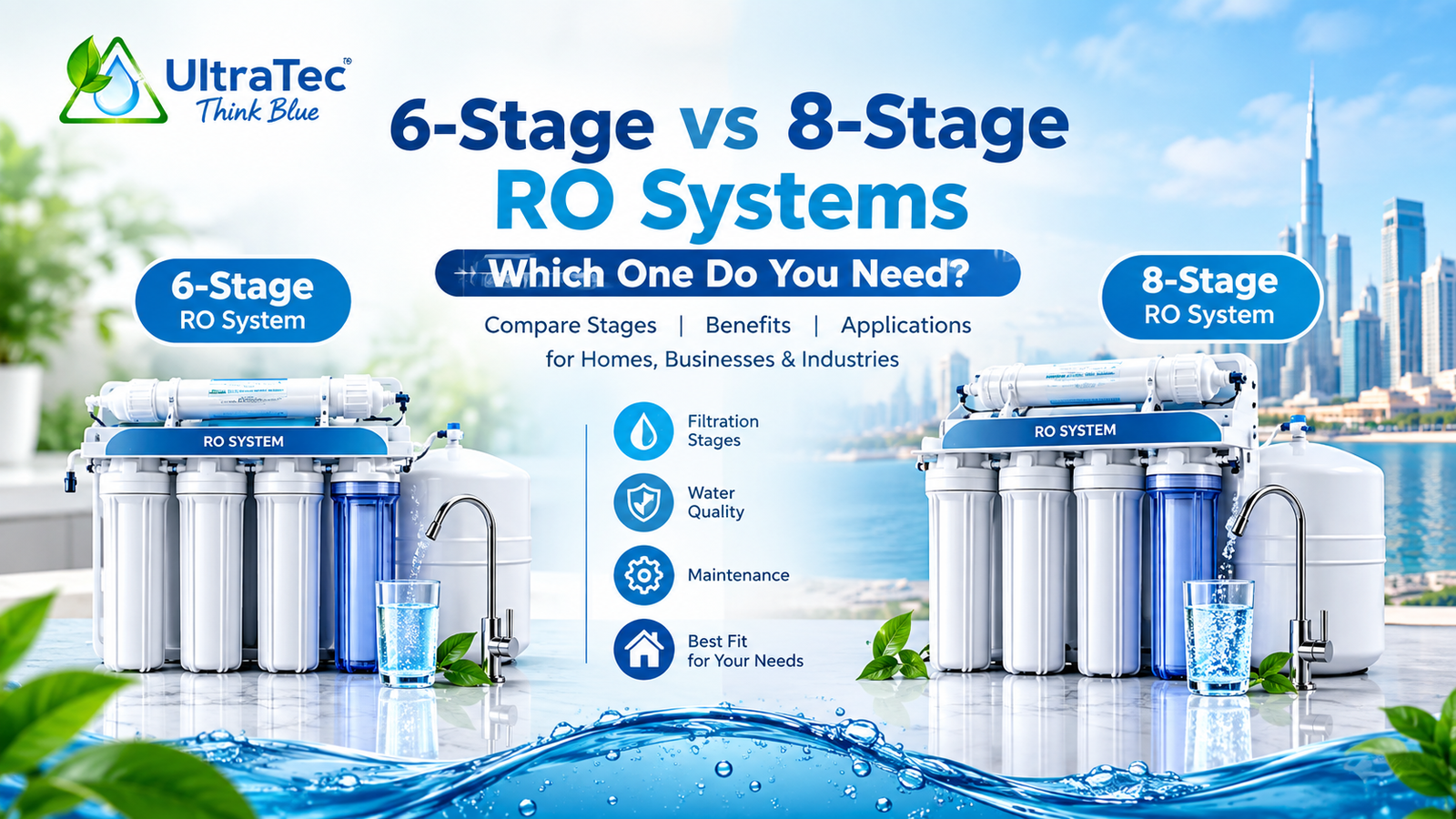
6-Stage vs 8-Stage RO Systems: Which One Do You Need?
If you're comparing a 6-stage vs 8-stage RO system, the most important thing to understand is that more stages do not automatically mean better water quality. The right configuration depends on your incoming water quality, TDS level, required output, contaminants, daily consumption and whether the system is intended for a home, office, commercial facility or industrial application.
A 6-stage RO system may already provide an effective combination of sediment filtration, activated carbon filtration, reverse osmosis and post-treatment. An 8-stage system may add additional treatment such as UV disinfection, remineralization, an additional carbon stage or another polishing stage. The value of those additional stages depends on what your water actually needs.
For UAE applications, this distinction matters. A properly designed water filtration system in Dubai or elsewhere in the UAE should be selected according to the source-water characteristics and required treated-water specification rather than simply choosing the system with the largest number printed on the box. EPA guidance similarly explains that treatment selection should consider factors such as source-water chemistry and turbidity.
What Is an RO Water Purifier?
A reverse osmosis water purifier uses pressure to push water through a semi-permeable membrane. The membrane allows water to pass while restricting many dissolved salts, minerals and other contaminants. The process produces a treated-water stream, known as permeate, and a concentrated reject stream.
This is why RO is fundamentally different from a simple sediment or carbon filter. A sediment filter is primarily designed to capture suspended particles, while activated carbon is commonly used for adsorption of compounds affecting taste, odor and certain contaminants. RO provides a much broader dissolved-contaminant reduction barrier.
How Reverse Osmosis Works
A typical RO system begins with pre-filtration. Sediment filtration protects downstream components from particles, while activated carbon can help reduce chlorine and organic compounds that may affect the RO membrane.
Water is then pressurized and passed through the RO membrane. The membrane becomes the system's primary dissolved-contaminant barrier. Depending on the design and feedwater, additional stages can then polish, disinfect or condition the treated water.
The Water Quality Association describes RO as a membrane separation process and notes that RO is commonly combined with technologies such as activated carbon and UV as part of a multi-barrier treatment approach.
RO Stages Comparison: 6-Stage vs 8-Stage
The term "6-stage" or "8-stage" is not a universal technical standard. Manufacturers can configure these stages differently, so two systems with the same stage count can have very different performance.
A common 6-stage residential configuration might include:
- Sediment filter
- Activated carbon filter
- Carbon block filter
- RO membrane
- Post-carbon filter
- Final polishing or mineral stage
An 8-stage configuration could add UV treatment, remineralization, additional carbon filtration or another polishing stage.
Typical 6-Stage RO Configuration
A well-designed 6-stage system can be more than adequate for drinking-water applications where the incoming water has already been appropriately assessed. The important components are not simply the number of cartridges but their filtration ratings, membrane quality, flow capacity and suitability for the feedwater.

For example, UltraTec lists a commercial stainless-steel RO purifier using a 50 GPD/TFC membrane, 5-micron sediment filtration, two GAC filters and post-carbon filtration, with models available at 50, 75 and 100 GPD.
Typical 8-Stage RO Configuration
An 8-stage system generally provides additional treatment beyond the core RO process. Depending on the manufacturer, this might include UV disinfection, mineralization, alkaline treatment, an extra carbon stage or another polishing filter.
That does not automatically make it superior. If an additional stage does not address a relevant water-quality issue, it may simply increase system complexity, replacement costs and maintenance requirements.
6-Stage vs 8-Stage RO Comparison

| Feature | 6-Stage RO | 8-Stage RO |
|---|---|---|
| Sediment filtration | Usually | Usually |
| Carbon filtration | Usually | Usually |
| RO membrane | Yes | Yes |
| Post-carbon filtration | Common | Common |
| UV treatment | Optional | More commonly included |
| Mineral/remineralization stage | Optional | More commonly included |
| System complexity | Lower | Higher |
| Maintenance | Generally simpler | Potentially more |
| Best suited for | Homes, offices, standard drinking water | Users needing additional polishing/disinfection |
| Key deciding factor | Water quality + application | Water quality + additional treatment needs |
Don't choose between 6 and 8 stages based solely on the number. Choose based on the treatment objectives.
Does More RO Stages Mean Better Water?
Not necessarily. Think of RO stages like tools in a toolbox: having more tools does not mean every job requires every tool.
A properly selected 6-stage RO system can outperform a poorly designed 8-stage system if its membrane, pre-treatment, flow capacity and maintenance program are better suited to the source water. The same principle applies to commercial and industrial RO plants, where system design depends heavily on feedwater analysis and required production quality.
For industrial applications, UltraTec describes a design approach based on assessing existing water quality, flow requirements and output requirements before integrating technologies such as RO, UF, DI and specialized media filtration.
Key Benefits of Reverse Osmosis
RO is widely used because it can address a broad range of dissolved contaminants through a single membrane-based treatment process. EPA identifies RO and nanofiltration as technologies capable of removing a wide range of contaminants, including dissolved solids and various inorganic and synthetic organic contaminants.
TDS and Dissolved Contaminant Reduction
TDS, or total dissolved solids, is often one of the first measurements people consider when evaluating RO performance. However, TDS alone does not tell you everything about water safety or quality. Two water sources can have similar TDS readings while having very different chemical compositions.
That is why a professional RO water treatment system should be selected after considering the actual source-water profile rather than using TDS as the only design parameter.
Which RO System Is Better for UAE Water?
There is no single RO configuration that is automatically best for every property in Dubai or the wider UAE.
A residential customer may need a compact drinking-water purifier. A restaurant may require a higher-capacity commercial RO system. A hotel, factory or manufacturing facility may need a centralized industrial RO plant capable of producing thousands of gallons per day.

UltraTec, for example, lists commercial and industrial RO systems ranging from smaller units to large-capacity systems. Its published 18,000 GPD system specifies a 95–98% rejection range and 50–60% recovery under stated conditions, demonstrating why industrial RO performance is normally discussed using engineering parameters rather than simply counting filtration stages.
Residential, Commercial and Industrial RO Applications
For homes and offices, the focus is generally drinking and cooking water. For restaurants, hotels and food-service operations, water quality can also influence beverages, food preparation and equipment performance.
Industrial applications are considerably more demanding. RO may be integrated with multimedia filtration, water softening, chemical dosing, UV, ultrafiltration, deionization or EDI, depending on the required process-water specification.
UltraTec states that it provides commercial and industrial water systems and services including RO plants, water softeners, UV sterilizers, deionization and demineralization systems.
RO vs UV, UF, Carbon Filtration and Water Softeners
RO is not a replacement for every other water-treatment technology.
UV filtration is primarily a disinfection technology. Activated carbon is useful for adsorption and improving taste and odor. UF uses a membrane with a different separation range from RO. Water softeners are designed primarily to reduce hardness-causing ions rather than provide the same broad dissolved-solids reduction as RO.
In many real installations, these technologies work together. The Water Quality Association describes this multi-barrier approach as a way of addressing a wider range of contaminants than a single treatment process can handle alone.
RO System Maintenance and Filter Replacement
Even the best RO membrane cannot compensate for neglected pre-filters. Sediment and carbon filters protect the membrane, and their condition directly affects system performance.
Maintenance should typically include monitoring pressure, flow, TDS/rejection performance, leaks, filter condition and membrane performance. Replacement intervals should be determined by the manufacturer's specifications and actual feedwater conditions rather than an arbitrary calendar alone.
EPA notes that RO systems require periodic replacement of filter cartridges and membranes.
What Happens When Filters Are Not Maintained?
Clogged pre-filters can restrict flow and increase pressure requirements. Exhausted carbon filtration can reduce protection for downstream components, while a deteriorating RO membrane can result in declining rejection and increasing product-water TDS.
For commercial and industrial plants, preventive maintenance becomes even more important because unexpected downtime can affect production.
How to Choose the Right RO System
Before purchasing an RO purifier, ask:
- What is the source of the water?
- What is the incoming TDS level?
- What contaminants need to be reduced?
- How much treated water is required per day?
- Is the system residential, commercial or industrial?
- Is UV disinfection required?
- Is remineralization required?
- What recovery rate is appropriate?
- How will reject water be handled?
- What maintenance and replacement support is available?
For larger systems, a proper water analysis and engineering assessment should come before equipment selection.
EPA also highlights an important consideration: RO produces a reject stream and can consume significant amounts of water, so efficiency should be part of the selection process.
UltraTec RO Water Treatment Solutions
UltraTec Water Treatment LLC has operated in the UAE water-treatment market since 1999 and states that it has 25 years of water-treatment experience, serving commercial and industrial applications. Its portfolio includes reverse osmosis plants, water softeners, UV systems, deionization, demineralization, carbon filtration and related water-treatment equipment.
For industrial requirements, UltraTec provides systems including brackish-water RO, seawater RO, containerized RO plants and commercial RO systems. Its industrial water-treatment offering emphasizes assessment of water quality, flow requirements and output requirements before system design and installation.
This approach is particularly useful for UAE businesses where the correct system may involve considerably more than choosing between six and eight cartridge stages.
Explore UltraTec's industrial water filtration solutions
Frequently Asked Questions
Is a 6-stage RO better than an 8-stage RO?
Not automatically. A 6-stage system can provide excellent treatment when its filters and RO membrane are correctly matched to the source water. An 8-stage system is useful when its additional stages address a specific treatment requirement.
What is the main difference between 6-stage and 8-stage RO?
The main difference is usually the additional treatment or polishing stages. However, the exact configuration varies by manufacturer, so stage count alone should not be used to compare systems.
Does an 8-stage RO reduce TDS more?
Not necessarily. TDS reduction depends heavily on the RO membrane, feedwater conditions, operating pressure, membrane condition and system design. Additional post-treatment stages may not significantly improve the RO membrane's TDS rejection.
How often should RO filters be replaced?
There is no universal replacement schedule. Filter life depends on feedwater quality, consumption and system design. Performance monitoring and manufacturer recommendations should guide replacement decisions.
Is RO suitable for Dubai and UAE water?
RO can be suitable for many UAE applications, but the appropriate design depends on the water source and required output. Commercial and industrial applications should ideally be engineered using water-quality data.
Does an RO system waste water?
Yes. RO produces a treated-water stream and a concentrated reject stream. The amount varies substantially by system design and operating conditions. EPA notes that efficiency varies among systems, with modern efficient designs able to reduce water waste significantly.
Do businesses need commercial RO systems?
Businesses with higher water demand may benefit from a commercial RO system because residential units may not provide the required production rate, reliability or operating configuration. Hotels, restaurants, factories, clinics and other facilities should select capacity based on their actual daily demand and water-quality requirements.
Conclusion
The best RO stages comparison is not simply a competition between six and eight. The better question is: what does your water actually need?
A 6-stage RO system can be an efficient choice for many residential and office applications, while an 8-stage configuration may make sense when additional disinfection, mineralization or polishing is required. For commercial and industrial users, however, the conversation should move beyond stage count toward membrane selection, capacity, recovery, pretreatment, water analysis and long-term maintenance.
For reliable RO water purification in Dubai, UAE and international markets, UltraTec can assess your application and develop a treatment solution around your actual water-quality and production requirements.
Need help selecting the right RO system? Contact UltraTec Water Treatment LLC for professional water filtration, commercial RO and industrial RO plant solutions.