
Hard Water Problems in Dubai: Signs, Causes & Solutions
Hard water can be easy to overlook. You may notice white marks around taps, soap that does not lather properly, scale inside a kettle, or reduced performance from a water heater—but these everyday signs can indicate a larger water-quality issue.
Hard water problems in Dubai are mainly associated with dissolved minerals such as calcium and magnesium. When these minerals accumulate, they can contribute to limescale, soap residue and scaling in plumbing, fixtures, heaters and other equipment.
The good news is that hard water can be assessed and treated. Depending on the source-water chemistry and application, a properly selected water softener, filtration system, RO system or combination of technologies can help manage hardness and other water-quality concerns.
For homes, villas, commercial buildings and industrial facilities across the UAE, the right solution should be based on actual water analysis—not simply on a one-size-fits-all treatment system.
What Is Hard Water?
Hard water contains elevated concentrations of dissolved minerals, primarily calcium and magnesium.
Water hardness is commonly reported as milligrams per litre (mg/L) expressed as calcium carbonate (CaCO₃). Hardness is a natural characteristic of many water sources and is not, by itself, considered a health hazard at typical drinking-water levels. However, it can create operational, aesthetic and maintenance problems.

The World Health Organization notes that hardness can affect the acceptability of drinking water and contribute to scale deposition and increased soap consumption.
A commonly used classification is:
| Hardness as CaCO₃ | General classification |
|---|---|
| 0–75 mg/L | Soft |
| 75–150 mg/L | Moderately hard |
| 150–300 mg/L | Hard |
| 300+ mg/L | Very hard |
These ranges are useful for general understanding, but treatment decisions should be based on a complete water analysis and the intended application.
7 Common Signs of Hard Water Problems at Home in Dubai
If you are experiencing several of the following symptoms, testing your water hardness can be a sensible first step.
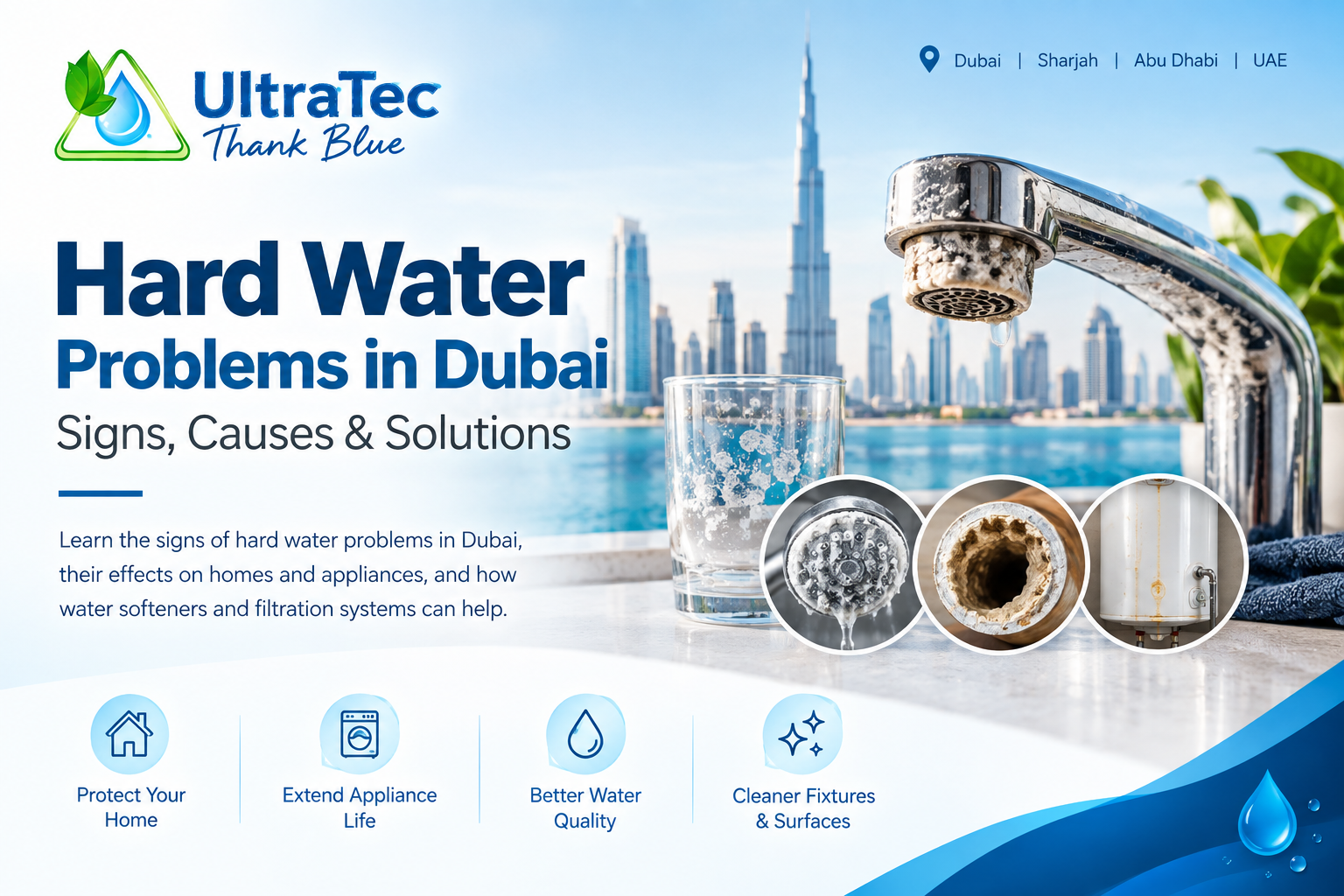
1. White Scale Around Taps and Showerheads
One of the most visible signs of hard water is a white or chalky deposit around faucets, showerheads and bathroom fixtures.
As water evaporates, dissolved minerals can remain behind and gradually form deposits.
Over time, this buildup can restrict small openings in showerheads and aerators.
2. White Spots on Glassware and Dishes
Do your glasses still have cloudy or white marks after washing?
Hard water can leave mineral deposits on dishes, glassware and stainless-steel surfaces, particularly when water droplets evaporate before being fully rinsed away.
This can make clean dishes appear dull even when the dishwasher is functioning properly.
3. Soap Does Not Lather Easily
Hard water can react with soap and reduce its ability to form a rich lather.
You may find yourself using more soap, shampoo or detergent to achieve the same cleaning effect.
The resulting residue can also contribute to a sticky feeling on skin, bathroom surfaces and fabrics. The EPA identifies reduced soap lathering and residue as common effects associated with hard water.
4. Scale Inside Water Heaters
This is one of the more important hard-water issues for homes and businesses.
When heated, water containing hardness minerals can promote scale formation on heating surfaces. A layer of scale can interfere with heat transfer and contribute to reduced efficiency.
Hard-water scale can affect:
- Water heaters
- Boilers
- Heat exchangers
- Coffee machines
- Dishwashers
- Hot-water plumbing
- Industrial process equipment
The WHO notes that scale deposition in heated-water applications can reduce heat-transfer efficiency.
5. Dry or Rough Skin and Hair
Some people notice that their skin feels dry or that hair feels less smooth after washing with hard water.
This can partly relate to the interaction between hardness minerals, soap and shampoo residues.
However, skin or hair symptoms alone should not be used to diagnose hard water. If these issues are persistent, a water test provides a much better indication of whether hardness is actually involved.
6. Frequent Limescale Cleaning
If you constantly need to remove mineral deposits from bathrooms, kitchens or appliances, hard water may be contributing to the problem.
Repeated cleaning is not only inconvenient—it can indicate that minerals are continually entering the household water system.
7. Reduced Flow Through Small Fixtures
Mineral deposits can gradually accumulate inside narrow passages such as faucet aerators, showerheads and certain plumbing components.
In severe cases, scale can contribute to restricted flow.
That does not mean every low-flow problem is caused by hardness. Pressure issues, clogged filters, valves and plumbing faults can produce similar symptoms.
What Causes Hard Water Problems in Dubai?
Hardness occurs because water picks up dissolved minerals from its source and surrounding geological materials.
The main contributors are:
- Calcium
- Magnesium
- Bicarbonates
- Carbonates
- Sulfates and other associated ions
Hardness is different from TDS (Total Dissolved Solids). TDS measures the total concentration of dissolved substances, whereas hardness specifically refers mainly to calcium and magnesium.
This distinction matters when selecting a treatment system.
A high TDS reading does not automatically mean that a water softener is the correct solution.
A water analysis should determine what is actually present in the water.
Is Hard Water a Health Problem?
Generally, water hardness itself is not considered a health concern at the levels normally found in drinking water.
The WHO does not establish a health-based guideline value for hardness because it is not considered a health concern at levels found in drinking water. Instead, hardness is more relevant to taste, acceptability, scaling and household/industrial operation.

This is an important distinction.
A water softener is primarily installed to manage hardness and its operational effects, not because all hard water is unsafe to drink.
If the concern is bacteria, chlorine, dissolved solids, heavy metals or other contaminants, a different treatment technology may be necessary.
Hard Water vs. Other Water-Quality Problems
Not every water problem is a hard-water problem.
| Water issue | Typical concern | Potential treatment |
|---|---|---|
| Hardness | Calcium & magnesium scale | Water softener |
| High TDS | Dissolved salts/minerals | RO / desalination |
| Sediment | Sand, particles, rust | Sediment filtration |
| Chlorine | Taste and odour | Activated carbon |
| Microbiological contamination | Bacteria/pathogens | Appropriate disinfection/filtration |
| Iron/manganese | Staining, taste, deposits | Specialized treatment |
| Scale tendency | Mineral deposition | Softening/conditioning + process control |
This is why water testing should come before selecting equipment.
How to Test for Hard Water in Dubai
The simplest way to confirm a hardness issue is to have the water tested.
A professional water analysis may examine:
- Total hardness
- Calcium
- Magnesium
- TDS
- pH
- Conductivity
- Alkalinity
- Chloride
- Sulfate
- Iron
- Other parameters relevant to the application
For commercial and industrial facilities, additional parameters may be required.
Dubai has an established water-quality monitoring infrastructure. DEWA's Central Laboratory performs physical, chemical and biological water-quality testing, while Dubai Municipality has also expanded household water-quality testing capabilities.
For a private property, villa or commercial facility, the practical approach is to test the actual water entering the building and then size treatment equipment according to the measured results and expected water demand.
What Is the Best Solution for Hard Water in Dubai?
There is no single treatment system that is best for every property.
For conventional hardness removal, cation-exchange water softeners are one of the established technologies used to remove calcium and magnesium from water. They exchange hardness ions for sodium or potassium ions using a resin bed.
A typical softener consists of:
- Mineral/resin tank
- Ion-exchange resin
- Brine tank
- Control valve
- Regeneration system
During normal operation, hard water passes through the resin. Calcium and magnesium are exchanged by ions held on the resin.
When the resin becomes exhausted, the system enters a regeneration cycle to restore its capacity.
Water Softener vs. RO System: Which One Do You Need?
This is one of the most important distinctions when dealing with hard water problems in Dubai.
Water Softener
A water softener is primarily designed to address hardness.
It can be appropriate when the major concern is:
- Limescale
- Calcium and magnesium
- Soap performance
- Appliance scaling
- Hot-water equipment protection
Reverse Osmosis
RO is designed to reduce a much broader range of dissolved substances and can significantly reduce TDS.
It may be appropriate for:
- Drinking-water purification
- High-TDS water
- Brackish water
- Commercial applications
- Industrial processes
- Specific contaminant-reduction requirements
UltraTec provides commercial and industrial RO systems in a range of capacities, including systems designed for brackish-water treatment and commercial applications.
Sometimes You Need Both
A treatment train can include pre-filtration → softening → RO → post-treatment, depending on the incoming water and final water-quality requirement.
Softening may also be used as pretreatment for certain downstream purification systems.
The EPA identifies water softening as a common pretreatment step for applications including boiler feed water and other water-purification processes.
How to Choose a Water Softener in the UAE
Choosing a softener based only on the property's size is not enough.
A professional system selection should consider:
1. Incoming Water Hardness
Higher hardness requires greater treatment capacity.
2. Daily Water Consumption
A villa with several residents has different requirements from a hotel, restaurant or commercial building.
3. Peak Flow Rate
The system must be capable of supplying the required flow when multiple fixtures operate simultaneously.
4. Regeneration Requirements
Traditional ion-exchange systems require regeneration. The regeneration frequency depends on water hardness, resin capacity and consumption.
5. Salt and Water Efficiency
Modern systems can be configured to regenerate according to actual demand rather than relying on a fixed schedule.
The EPA recommends considering demand-initiated regeneration and water- and salt-efficient designs when selecting a softener.
6. Installation Space
Consider the available area for the resin tank, brine tank, valves, drainage and maintenance access.
7. Water Quality Beyond Hardness
If the source also has high TDS, iron, sediment or microbiological concerns, additional treatment may be required.
Hard Water Treatment for Villas, Homes and Buildings in Dubai
Dubai properties can have very different water-treatment requirements.
A residential villa may need a whole-house softening system to address hardness-related scale, while drinking water may require a separate RO system.
For apartment buildings, hotels, restaurants and commercial facilities, the design needs to consider:
- Number of occupants
- Daily consumption
- Peak demand
- Hot-water requirements
- Existing plumbing
- Storage tanks
- Water-quality parameters
- Maintenance requirements
A properly designed system should address the actual water-quality problem rather than simply adding more filtration stages.
Hard Water Treatment for Sharjah and Abu Dhabi
The same principle applies across the UAE.
Whether the property is in Dubai, Sharjah, Abu Dhabi or another emirate, water-treatment requirements should be determined from the actual source-water characteristics and application.
A solution designed for one property should not automatically be copied to another.
For commercial and industrial facilities, site conditions, production requirements and process-water specifications become even more important.
UltraTec develops customized water-treatment systems for residential, commercial and industrial applications and operates from Dubai, serving UAE and international requirements. Its company profile describes experience with RO, desalination, filtration and customized water-treatment systems across multiple countries.
Why Professional Water Treatment Design Matters
A water softener that is too small may regenerate too frequently and fail to meet demand.
An oversized system may unnecessarily increase capital and operating costs.
Likewise, installing an RO system when the only problem is hardness may not be the most appropriate or economical approach.
Professional system design should consider:
Water test → treatment objective → flow requirement → system sizing → installation → commissioning → maintenance
This approach helps create a system that is technically appropriate and easier to operate over its service life.
How UltraTec Can Help With Hard Water Problems in Dubai
UltraTec Water Treatment LLC provides water-treatment solutions for residential, commercial and industrial applications in the UAE.
Its portfolio includes water softeners, filtration systems, RO plants, desalination systems and customized water-treatment solutions. UltraTec states that it designs systems according to customer requirements and provides installation, commissioning and ongoing technical support.

For a hard-water issue, the process can start with understanding the water source and testing the relevant parameters. From there, the appropriate combination of softening, filtration, RO or other treatment technologies can be considered.
Visit UltraTec Water Treatment LLC
If you are experiencing scale buildup, poor soap lathering, white deposits or appliance scaling in Dubai, Sharjah or Abu Dhabi, speak with a water-treatment specialist before purchasing a system.
Frequently Asked Questions About Hard Water Problems in Dubai
Is hard water common in Dubai?
Water hardness can vary according to the water source, treatment process and conditions within a building. Instead of assuming that every Dubai property has the same hardness level, the most reliable approach is to test the water at the property.
What are the main signs of hard water?
Common signs include white mineral deposits, limescale around taps and showerheads, reduced soap lather, residue on dishes and scale accumulation in water heaters and other equipment.
Is hard water safe to drink?
Hardness itself is generally not considered a health concern at typical drinking-water levels. However, hardness is only one water-quality parameter, so a complete water-quality assessment may be appropriate if drinking-water safety is the concern.
Does hard water damage water heaters?
Hard water can contribute to scale formation on heating surfaces. Scale can interfere with heat transfer and affect the efficiency and operation of hot-water equipment.
Does an RO system remove hard water?
RO can reduce calcium, magnesium and many other dissolved substances, but RO and water softeners serve different purposes. The correct choice depends on the water analysis and the required treated-water quality.
Is a water softener better than an RO system?
Neither is universally better. A softener is primarily intended for hardness control, while RO is designed for broader dissolved-contaminant reduction. In some applications, both technologies may be used together.
How often does a water softener regenerate?
Regeneration frequency depends on the incoming hardness, water consumption, resin capacity and control settings. Demand-initiated regeneration can help match regeneration to actual usage and improve efficiency.
Can hard water cause white stains on bathroom fixtures?
Yes. When hard water evaporates, dissolved minerals can remain on surfaces and contribute to white or chalky deposits.
How can I check water hardness in Dubai?
A laboratory water analysis is the most reliable approach. A hardness test should ideally be considered alongside TDS, pH, conductivity and other parameters relevant to the property's water source and intended use.
Does UltraTec provide water treatment solutions in Dubai?
Yes. UltraTec Water Treatment LLC is based in Dubai and provides residential, commercial and industrial water-treatment solutions, including softening, filtration, RO and desalination systems.
Conclusion
Hard water problems in Dubai are not always dramatic at first. They often begin with small signs—white deposits, soap residue, cloudy glassware or scale around heating equipment.
The important step is to identify the cause before selecting a treatment system.
Water softeners can be an effective solution when calcium and magnesium hardness are the primary concern, while RO, filtration, disinfection and other technologies may be required for different water-quality challenges.
For homes, villas, hotels, restaurants, commercial buildings and industrial facilities across the UAE, the best approach is a water-analysis-led treatment design.
Explore UltraTec's water-treatment solutions and discuss your water-quality requirements with a qualified treatment specialist.